Hongsheng Zhang, a researcher at the University of Jinan in China, has published work arguing that travelling into one's own past is impossible across a wide range of theoretical universes, Euronews.com reports. The study, which is still awaiting peer review, also identifies the only two mechanisms by which a time machine could, in principle, send someone backward. Zhang's findings were reported by Euronews.com and discussed by the researcher with ScienceAlert.
The argument rests on a single feature of relativity: the direction of light can never sit at ninety degrees to the direction in which an object moves through time. Picture spacetime divided into layers that light itself can travel along. Anything moving slower or faster than light must cross those surfaces in the same direction — comparable to climbing a staircase that never allows a step down. According to Euronews.com, the reasoning requires no exotic matter, no quantum effects and no assumptions about what fills the universe. Zhang told ScienceAlert that the whole content of the argument is "just accounting for directions."
Why it matters
Physicists call journeys into the past "closed timelike curves" — paths through spacetime that return to the exact place and moment where they began. Einstein's equations permit them in certain scenarios, such as near the core of a rotating black hole. If Zhang's conclusion holds, a large category of those solutions would be ruled out, narrowing where any future time machine could exist. The work does not settle whether our own universe allows backward travel; that question remains open, and Zhang told ScienceAlert it is the one he would most like to see answered.
Two ways a time machine could work
Zhang's research also sets out precisely how a machine could manage to travel backward, and says there are only two routes. The first is twisting. Imagine light rays that, instead of running side by side, spiral around one another like the strands of a rope. When that happens, the orderly light surfaces stop forming, so the one-dimensional staircase that forces you to keep climbing no longer exists.
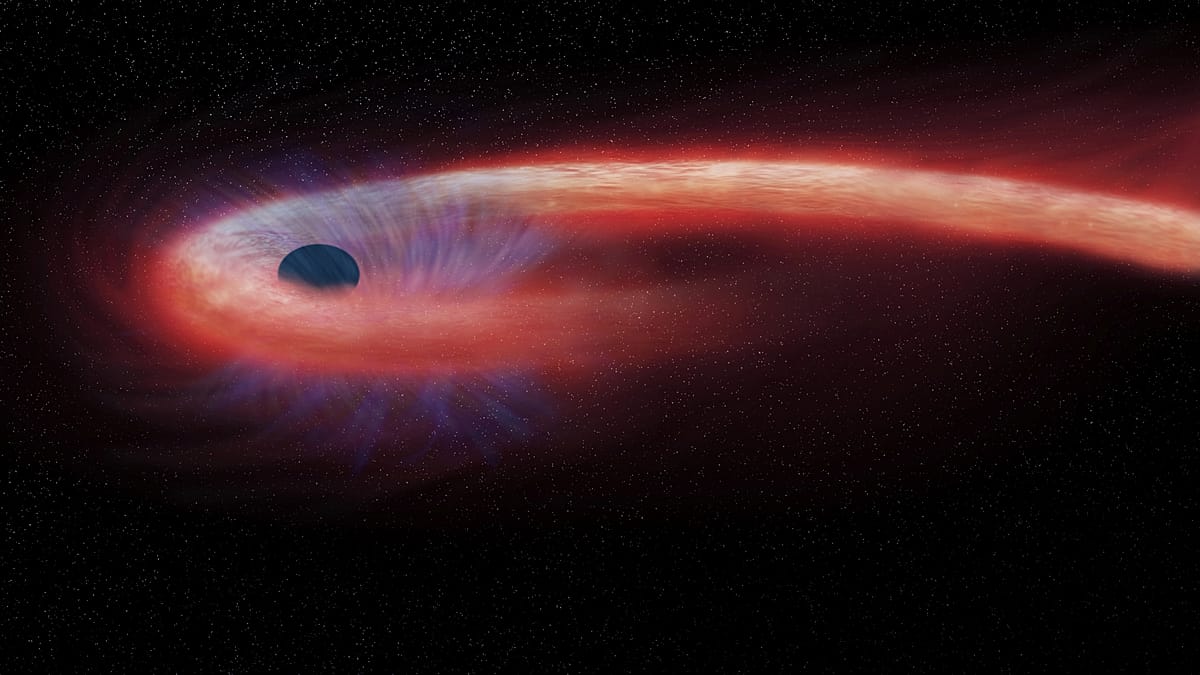
This is what occurs near the centre of a rotating black hole. Einstein's theory holds that a spinning mass drags space and time along with it — an effect NASA's Gravity Probe B satellite measured around Earth in 2011. Close to the black hole's core, the drag is strong enough that motion "forward in time" bends around into a circle. A traveller following that circle would see their clock advance normally, yet the journey would arrive back at the moment of departure. The physicist Brandon Carter demonstrated in 1968 that such loops exist inside rotating black holes, according to Euronews.com.
The second route is the shape of the universe itself. The staircase may be perfectly built but wrap around the sides of a building, so that the top step leads straight back to the first — like the impossible stairs in an Escher drawing. You would keep climbing and always end up where you started. Most time machines physicists have designed on paper, including those built from wormholes, rely on this trick.
Forward travel is already established
Travelling into the future, by contrast, is well documented. Einstein showed that moving very fast or sitting in a strong gravitational field slows your clock relative to everyone else's. According to the European Space Agency, astronauts aboard the International Space Station return to Earth a few thousandths of a second younger than they would otherwise be.
Euronews.com notes that the study leaves unresolved whether our own universe permits a trip to the past. Anyone planning a journey might, for now, pack for tomorrow rather than yesterday.
Watch for peer review of Zhang's paper, and for follow-up work testing whether the two permitted mechanisms can exist in a universe like ours.